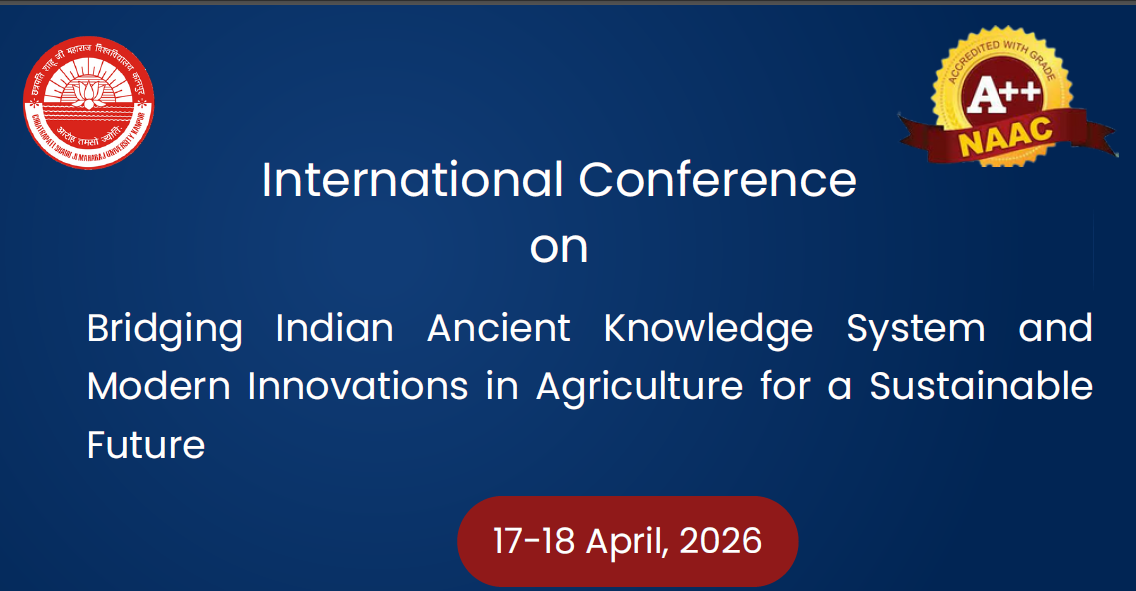
International Conference on ‘Bridging Indian Ancient Knowledge System and Modern Innovations in Agriculture for a Sustainable Future’
About the conference:
The International Conference on Bridging Traditional Wisdom and Contemporary Agricultural Science for a Sustainable Future (BTWCASSF 2026) is being organized by the School of Advanced Agricultural Sciences and Technology (SAAST), Chhatrapati Shahu Ji Maharaj University, Kanpur (U.P.), India during April 17-18, 2026.
Agriculture today is witnessing a historic transformation a shift from traditional, indigenous, and community-driven farming systems to modern, technology-enabled, precision-based agriculture. The future of global food systems lies not in replacing one with the other, but in harmonizing the strengths of both: the resilience, sustainability, and ecological balance of traditional knowledge with the efficiency, accuracy, and scalability of modern scientific innovations.
The conference aims to explore how traditional agricultural wisdom such as mixed cropping, natural soil fertility management, local seed conservation and community-based resource governance can synergize with modern tools including IoT, AI, drones, sensors, biotechnology, climate modelling, protected cultivation, and digitally integrated value chains.
BTWCASSF 2026 will serve as a global platform for scientists, policymakers, innovators, entrepreneurs, start-ups, industry leaders, extension professionals and students to share their work, build collaborations, and shape strategies for a sustainable, climate-resilient, and innovation-driven agricultural future.
Special focus areas include:
Bridging traditional wisdom with high-tech agriculture
Innovation-led agribusiness and entrepreneurship
Climate resilience and ecological sustainability
Green, circular, and regenerative agricultural models
Digital transformation and modern value chains
Youth and women empowerment in future-ready agriculture
Through keynote addresses, thematic sessions, technical tracks, poster presentations, innovation showcases, and policy dialogues, the conference aims to generate actionable pathways for an agricultural future that is smarter, greener, inclusive, and deeply rooted in both heritage and innovation.
Themes of International Conference
Theme 1: Smart, Climate-Resilient and Sustainable Farming Systems
(Integrating Indian ancient wisdom with modern high-tech solutions)
Indigenous climate-resilient practices integrated with precision agriculture
Digital farming tools including sensors, IoT, drones, and data analytics
Remote sensing and GIS for climate forecasting and farm decision-making
Traditional and modern approaches to soil and water conservation
Stress tolerance strategies combining ancient insights and modern science
Organic, natural, regenerative, and conservation agriculture
Traditional cropping systems strengthened through climate-smart models
Theme 2: Sustainable Resource Management, Crop Improvement and Green Biotechnology
(Linking heritage seed systems with genomic innovation)
Indigenous organic inputs integrated with modern nutrient and water management
Biodiversity conservation supported by digital and geospatial monitoring
Conservation of landraces alongside molecular breeding and genome editing
Development of climate-resilient varieties using indigenous germplasm
Community seed banks connected with advanced seed technologies
Application of big data, genomics, proteomics, and bioinformatics in crop improvement
Theme 3: Integrated Crop and Livestock Health Management
(Traditional bio-remedies combined with modern diagnostics and precision tools)
Indigenous botanical formulations integrated into modern IPM strategies
Biopesticides, biocontrol agents, and eco-friendly plant protection
AI-based pest and disease forecasting and surveillance systems
Resistance management and safe, sustainable plant protection practices
Ethno-veterinary knowledge blended with precision livestock technologies
Traditional fish farming integrated with modern aquaculture innovations
Integrated crop–livestock systems for circular and sustainable agriculture
Theme 4: Horticulture, Allied Sectors and Post-Harvest Innovations
(From indigenous practices to high-tech production systems)
Traditional horticultural practices and modern protected cultivation
Hydroponics, aeroponics, vertical farming, and smart greenhouses
Indigenous post-harvest knowledge enhanced through mechanization and cold chains
Value addition, food processing, nutraceuticals, and functional foods
Renewable energy and eco-friendly technologies in allied agricultural sectors
Theme 5: Agribusiness, Agri-Entrepreneurship and Rural Economic Transformation
(Empowering farmers, start-ups, and rural enterprises through innovation)
Agri-tech start-ups and innovation-driven entrepreneurship
Strengthening traditional rural enterprises using digital platforms
Digital transformation of agri-value chains and supply systems
FPOs as drivers of community-led agricultural modernization
Financial inclusion, fintech solutions, crop insurance, and risk management
Rural economic development linking indigenous systems with modern markets
Theme 6: Policy, Education, Extension and Innovation for a Sustainable Future
(Transferring heritage knowledge to next-generation agriculture)
Policy frameworks for sustainable, equitable, and climate-resilient agriculture
Integration of Indian ancient knowledge systems into extension services
ICT-enabled extension, mobile advisories, and digital knowledge platforms
Climate literacy, farmer training, and youth and women empowerment
Smart decision-support systems for sustainable farm management
Circular economy models blending traditional recycling with modern innovation
Cross-sectoral and high-tech innovations for long-term sustainability
5. Expected Outcomes
The conference is expected to:
Generate policy recommendations for integrating traditional and modern agricultural systems.
Promote research collaborations across institutions and countries.
Document best practices and success stories of heritage–technology convergence.
Encourage innovation through startup exhibitions, pitches, and industry interactions.
Strengthen networks among researchers, farmers, FPOs, innovators, NGOs, and agribusiness professionals.
Contribute to a roadmap for future-ready, resilient, and sustainable agriculture.
Notice : Only csjmu.ac.in and kanpuruniversity.org are our official websites. All other websites are fake( Fake Website Alert)
Best viewd in 1280X720 resolution.If website seems slow to load, please clear your browser cookies and refresh page.